


When it comes to Google Ads in 2025, crafting effective ad copy is not just a skill – it’s a necessity. With 6 billion ads shown daily, standing out is critical, especially for South African SMEs operating in competitive markets like Johannesburg and Cape Town. The secret? Using proven ad copy formulas that drive clicks and improve ROI.
Here’s what you need to know:
- Keyword-Focused Ads: Match search terms with benefits to boost relevance and lower costs.
- AIDA Framework: Grab attention, build interest, spark desire, and drive action.
- Problem-Agitate-Solution (PAS): Solve user pain points with clear, direct messaging.
- Hyper-Local Targeting: Combine location, keywords, and value to attract local leads.
These formulas are backed by data and psychological principles, helping businesses improve their Quality Scores, lower CPCs, and increase conversions. For example, moving from "Poor" to "Excellent" Ad Strength can boost conversions by 12%. Whether you’re a plumber in Durban or a financial adviser in Pretoria, these strategies work.
Key takeaway: Effective Google Ads copy doesn’t rely on guesswork. It’s about using structured formulas that resonate with your audience, improve relevance, and deliver measurable results.
The Google Ads Copywriting Secrets No One Talks About
Top Google Ads Copy Formulas for 2025
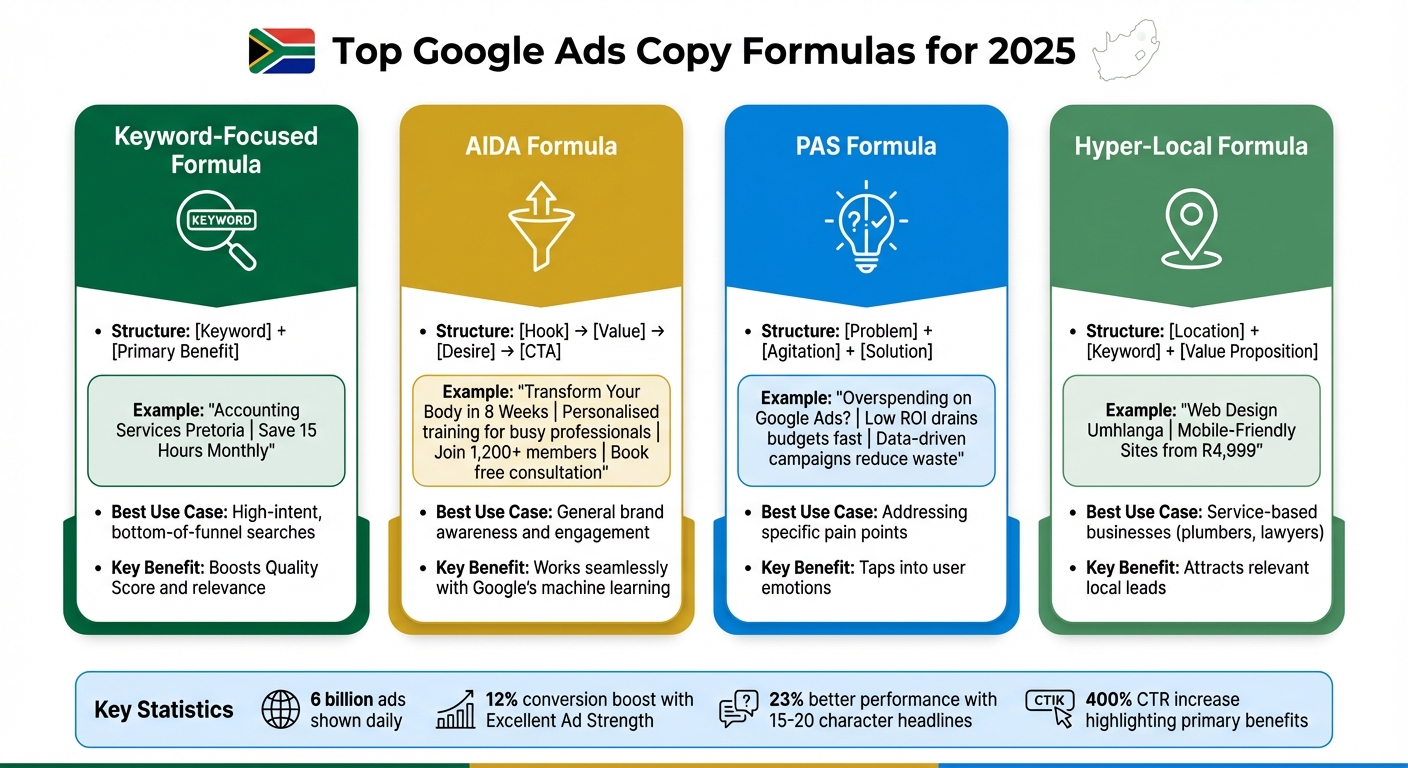
Google Ads Copy Formulas Comparison Guide 2025
Crafting compelling ad copy is essential for grabbing attention and driving clicks. Below are four tried-and-tested copywriting formulas for 2025, grounded in campaign data and psychological principles.
Keyword-Focused Formula
This formula is simple yet powerful: [Keyword] + [Primary Benefit]. It reflects the user’s search query while showcasing your value. For instance, if someone searches for "accounting services Pretoria", your ad headline could be: "Accounting Services Pretoria | Save 15 Hours Monthly".
Why does this work? When your headline mirrors the search term, it not only resonates with the user but also signals relevance to Google’s algorithm, boosting your Quality Score. This makes it a go-to approach for high-intent, bottom-of-funnel searches.
For South African small businesses, this formula is particularly effective. A Cape Town plumber might use: "Emergency Plumber Cape Town | 24/7 Same-Day Service". The keyword grabs attention, and the benefit speaks directly to the user’s need.
AIDA Formula (Attention-Interest-Desire-Action)
The AIDA framework remains a cornerstone of effective advertising, fitting perfectly within Google Ads’ character limits. Here’s the breakdown: start with a headline that grabs attention, use the description to build interest, highlight benefits to create desire, and end with a strong call to action.
Take this example for a fitness studio in Johannesburg:
- Headline: "Transform Your Body in 8 Weeks"
- Description: "Personalised training plans for busy professionals. Join 1,200+ members who’ve hit their goals. Book your free consultation today."
This approach works seamlessly with Google’s machine learning, which tests and optimises your ad combinations for better performance. A brand like Glossier has successfully used AIDA by leading with concepts like "accessible luxury" to draw interest, while sitelinks highlight affordability and specific products to drive action.
Problem-Agitate-Solution (PAS) Formula
If your audience is grappling with a specific challenge, the PAS formula is a great choice. It follows a straightforward structure: identify the problem, emphasise its consequences, and present your solution.
For example, a South African digital marketing agency might use:
- Headline: "Overspending on Google Ads?"
- Description: "Low ROI can drain your budget fast. Our data-driven campaigns reduce wasted spend and deliver qualified leads. Get a free audit today."
This formula resonates because it taps into the user’s emotions, offering relief and a clear way forward. It’s especially useful for service-based businesses like legal firms or consultants, where potential clients often face tight budgets and competitive challenges.
Hyper-Local Formula
With South Africa’s diverse geography, location-specific ads can make all the difference. The Hyper-Local Formula uses this structure: [Location] + [Keyword] + [Value Proposition]. Instead of casting a wide net over an entire city like "Johannesburg", you can target specific areas like "Sandton" or "Rosebank" to connect with local searchers.
For instance, a Durban web design agency might write: "Web Design Umhlanga | Mobile-Friendly Sites from R4,999". This approach reassures users that you’re nearby, understand their needs, and offer a solution tailored to their area. For service-based businesses – plumbers, electricians, lawyers – this formula is invaluable for attracting relevant leads while cutting unnecessary ad spend.
Summary Table of Formulas
| Formula | Structure | Best Use Case |
|---|---|---|
| Keyword-Focused | [Keyword] + [Primary Benefit] | High-intent, bottom-of-funnel searches |
| Hyper-Local | [Location] + [Keyword] + [Value Proposition] | Service-based businesses (plumbers, lawyers) |
| PAS | [Problem] + [Agitation] + [Solution] | Addressing specific pain points |
| AIDA | [Hook] → [Value] → [Desire] → [CTA] | General brand awareness and engagement |
These formulas equip your ads to address various buyer intents effectively. Up next, explore how to apply these strategies to create high-performing ads.
How to Use These Copy Formulas in 2025
Adapting these copy formulas to your audience is crucial, especially with Google’s shift towards AI-driven optimisation. Instead of crafting individual ads manually, you now supply multiple assets, and Google’s algorithm identifies the best combinations. However, for South African businesses, strategic testing and localisation remain essential.
A/B Testing for Better Copy Performance
Responsive Search Ads (RSAs) have become the standard, enabling you to upload up to 15 headlines and 4 descriptions. Google’s machine learning then mixes and matches these to find the best-performing combinations. While automation is effective, testing the quality of variations is still key.
Start by testing one element at a time. For instance, if you’re comparing the Keyword-Focused Formula with the PAS Formula, keep the descriptions consistent and only change the headlines. Run each test for at least two weeks to collect sufficient data. Google’s "Ad Variations" feature is particularly helpful for testing changes across multiple campaigns, which is ideal if you’re targeting different regions in South Africa.
Instead of obsessing over achieving a perfect Ad Strength score, focus on creating distinct and relevant headlines that stand out in a competitive market.
"Testing ad copy tends to fall by the wayside because bid adjustments and negative keywords… are much easier to generate quickly. That being said, there’s a ton of untapped value in split-testing your ad creative." – Allen Finn, Paid Search Marketing Expert
For South African small and medium-sized enterprises (SMEs), a monthly testing budget of ZAR 5,000–ZAR 10,000 is recommended. This ensures you collect enough data to identify high-performing ads before scaling. Use campaign-level asset reporting to identify underperforming headlines and replace them with variations of your top performers. For example, MyFlightSearch, an online travel agency, improved conversions by 14% and reduced cost per booking by 15% by focusing on "Good" and "Excellent" Ad Strength ratings with unique, keyword-rich headlines.
Short headlines are also trending in 2025. Headlines with 15–20 characters have been shown to outperform longer ones by 23%. Try concise options like "Plumber Sandton 24/7" and compare them to longer alternatives to see what resonates best.
Once your testing is complete, refine your ads to connect with local audiences.
Adapting Ad Copy for South African Audiences
Testing is just the beginning – tailor your ads to South African markets for maximum impact. Localisation goes beyond converting "dollars" to "rands." It’s about building trust with South African users by using local pricing, date formats (DD/MM/YYYY), and language. Google Ads supports ZAR billing and provides VAT-compliant invoices, simplifying expense tracking for businesses. For example, instead of saying "Web Design from $299", go with "Web Design from R4,999."
Regional targeting is vital in South Africa, where markets vary greatly. Johannesburg, for instance, is a hub for retail, real estate, and professional services but comes with higher competition and CPCs (ranging from ZAR 15 to ZAR 30 in finance). Cape Town’s audience leans towards luxury goods and tourism, while Durban’s diverse population favours cost-effective options in hospitality and food services. Adjust your Hyper-Local Formula accordingly: "Luxury Web Design Cape Town" versus "Affordable Web Design Durban."
South African audiences prefer clear, straightforward messaging. Skip vague phrases like "Transform Your Business Today" and opt for direct calls to action such as "Grow Your Sandton Business – Free Audit." This approach aligns with local communication styles and reduces resistance.
Dynamic features like location insertion can make your ads feel highly relevant. This feature automatically includes the user’s city in your ad. For example, a national plumbing service could use: "Emergency Plumber {LOCATION} | 24/7 Same-Day Service." A Pretoria-based user would see: "Emergency Plumber Pretoria", which builds immediate trust.
Prequalifying your audience is another effective strategy. If you’re offering premium services, include terms like "Premium" or specific price points such as "from R15,000" in your ad copy to avoid clicks from unqualified leads.
| Industry | Average CPC (ZAR) | Average CPA (ZAR) |
|---|---|---|
| E-commerce | R4 – R12 | R80 – R150 |
| Education | R5 – R15 | R100 – R250 |
| Healthcare | R10 – R25 | R200 – R500 |
| Finance | R15 – R30 | R300 – R800 |
(Source: Daiki Media, 2025)
sbb-itb-6f8605a
Why Choose Aion Marketing
Creating engaging ad copy is just the starting point. To truly succeed in South Africa’s competitive market, businesses need strategies backed by data and expert management. For small and medium enterprises (SMEs) in South Africa, partnering with Aion Marketing (https://aionmarketing.co.za) means campaigns designed to tackle local challenges head-on – whether it’s handling ZAR billing or understanding city-specific audience behaviours. This focused approach ensures your ads don’t just grab attention but also drive meaningful results.
Data-Driven Campaign Optimisation
At Aion Marketing, guesswork has no place. Every campaign is built on a foundation of continuous analysis and refinement. Here’s how it works: performance is tracked daily, search term reports guide weekly adjustments to bids and keywords, and ad creatives are reviewed monthly to identify winning strategies. If individual ad groups don’t generate enough data, insights are pooled from across campaigns to make faster, smarter decisions. This ensures that budgets are spent wisely, targeting high-value audiences based on demographics, interests, and previous interactions.
Sophisticated automated bidding strategies – like Target ROAS (Return on Ad Spend) and Target CPA (Cost Per Acquisition) – play a key role. These tools adjust bids in real time, processing thousands of data points that manual bidding simply can’t match. For example, in 2025, HelloFresh used Target ROAS bidding to achieve a 46% boost in conversions while meeting their efficiency targets. Similarly, TripAdvisor switched to Target CPA and saw a 29% increase in conversions without increasing costs.
For South African businesses, this data-driven approach aligns campaigns with specific goals. Whether it’s promoting high-margin products, leveraging seasonal trends, or targeting key areas in cities like Johannesburg and Cape Town, Aion Marketing ensures your ad copy remains relevant and impactful. And with a transparent reporting process, you’ll always know how your campaigns are performing.
Transparent Reporting for SMEs
Aion Marketing doesn’t just optimise campaigns – it also makes the results easy to understand. Clear reports track essential metrics like Click-Through Rate (CTR), Conversion Rate, and Impression Share, giving SMEs a straightforward view of their return on investment. These reports break down exactly how much is being spent per lead, with industry benchmarks such as ZAR 80–ZAR 150 for e-commerce and ZAR 300–ZAR 800 for finance.
What’s more, campaigns are tailored to local needs. From ZAR billing to VAT-compliant invoices, Aion Marketing eliminates the hassle of currency conversion fees and tax issues. This localised support allows you to focus on growing your business while your campaigns deliver measurable results.
Conclusion
A well-thought-out strategy can turn your ad spend into real results. Tried-and-tested approaches like AIDA, PAS, and Hyper-Local targeting can transform ordinary messaging into high-impact copy that stands out in South Africa’s competitive landscape. With single clicks costing anywhere from R90 to R900+, every Rand counts – and these methods ensure your investment works smarter for your business.
Highlighting a primary benefit can increase click-through rates (CTR) by an impressive 400%, while using numbered headlines can boost CTR by 217% and improve conversion rates by 23%. These aren’t just numbers – they’re tangible outcomes that directly affect your bottom line.
To stay ahead, South African SMEs need to set up Google Ads for success and move beyond outdated advertising methods. Ryder Meehan, Co-Founder and Co-CEO of Upgrow, sums it up perfectly:
"The harsh truth about Google Ads copywriting? Most advertisers are stuck in the past, following an outdated formula: ‘Want X? We’ve got X – and it’s good!’".
Breaking away from this pattern requires blending creativity with data. By combining these insights with a creative approach, businesses can achieve measurable growth.
Aion Marketing (https://aionmarketing.co.za) simplifies localised campaigns with features like ZAR billing, hyper-local targeting, and transparent reporting. With automated bidding and monthly reviews, your campaigns stay ahead while you focus on growing your business. This localised, data-driven approach makes it easy to implement strategies that deliver results.
The tools and formulas are ready – put them to work today.
FAQs
How can I use copywriting formulas to improve my Google Ads Quality Score?
Improving your Google Ads Quality Score hinges on crafting ad copy that resonates with user searches, encourages a higher click-through rate (CTR), and aligns seamlessly with your landing page experience. These three elements – relevance, expected CTR, and landing-page experience – are the building blocks of your Quality Score.
To achieve this, using proven copywriting structures can make all the difference. Take the “Keyword + Benefit” approach, for example (think “Plumbing Services – Same-Day Repairs”), which ensures your message is both direct and relevant. Or try the “Problem → Solution” formula (e.g., “Struggling with Slow Internet? Switch to Fibre Today”), which identifies a user’s challenge and immediately offers a solution. Other effective methods include “You + Benefit” (e.g., “Save R500 on Your First Solar Installation”) and engaging, question-based headlines (e.g., “Ready for Faster Internet?”). Including your target keyword and a clear value proposition in your ad copy signals relevance to Google, which can positively influence your expected CTR.
To put these strategies into action, start by mapping each ad group’s primary keyword to a fitting formula. Keep your headlines concise (up to 30 characters) and descriptions clear (up to 90 characters), using local South African spelling and the R symbol for prices (e.g., “Only R199/month”). Run A/B tests to compare variations, track CTR and landing-page metrics, and adjust your ads based on the data. Need expert help? Aion Marketing specialises in optimising campaigns to improve performance and boost your Quality Score.
What are the advantages of using hyper-local targeting for businesses in South Africa?
Hyper-local targeting is a game-changer for businesses in South Africa, allowing them to zero in on customers in specific geographic areas. This strategy ensures that ads are seen by the people most likely to engage – those right in your neighbourhood. For local businesses, it’s a powerful way to connect with potential customers who are already nearby and ready to act.
Here’s how hyper-local targeting can benefit businesses:
- Boost relevance: Ads are customised to address the immediate needs of local customers, making them far more engaging.
- Optimise your ad spend: By focusing only on nearby audiences, you avoid wasting money on people outside your service area.
- Drive local campaigns: Perfect for promoting limited-time offers, events, or new store openings in specific locations.
Imagine a restaurant in Cape Town using this approach to target nearby residents or tourists looking for dining options within a few kilometres. With hyper-local targeting, their marketing becomes both effective and cost-efficient, reaching the right people at the right time.
What’s the best way to test different Google Ads copy formulas effectively?
To get the most out of testing Google Ads copy, create 3-5 ad variations within the same ad group. Each variation should take a different angle – try approaches like problem-solving, focusing on benefits, or using a question to grab attention. Keep the budget, bidding strategy, and targeting consistent across all ads so that the only difference is the copy itself.
Let your test run for at least 7 days, or until each ad racks up 1,000+ impressions. During this time, track key metrics like click-through rate (CTR), cost-per-click (CPC) in Rands, and conversion rate. Once you’ve gathered enough data, identify the top-performing ad formula, pause the ones that aren’t working, and tweak your strategy for the next round of testing.
If your audience is in South Africa, take the time to localise your ads. Use the Rand symbol (R) for prices, South African date formats (like 15 December 2025), and metric measurements. These small, thoughtful details can help your ads resonate more with local users and boost your overall performance.


