


Using Meta Ads Manager effectively requires smart budget planning. Without a clear strategy, you risk wasting money or missing growth opportunities. Here’s what you need to know:
- Set clear goals: Define measurable objectives like increasing sales or generating leads.
- Start small: A daily spend of R100–R500 is a good baseline for South African SMEs.
- Allocate wisely: Spend 60–70% on conversions, 10–20% on awareness, and 10% on retargeting.
- Track performance: Use tools like Meta Pixel and Conversions API to monitor results.
- Stay flexible: Adjust budgets gradually (10–20% every few days) and refresh ad creatives every 2–4 weeks.
- Plan for seasons: Boost budgets during high-demand periods like Black Friday or December holidays.
With the right approach, Meta Ads can improve revenue by 80–130% while reducing acquisition costs by 15–25%. Follow these steps to ensure every rand works for your business goals.
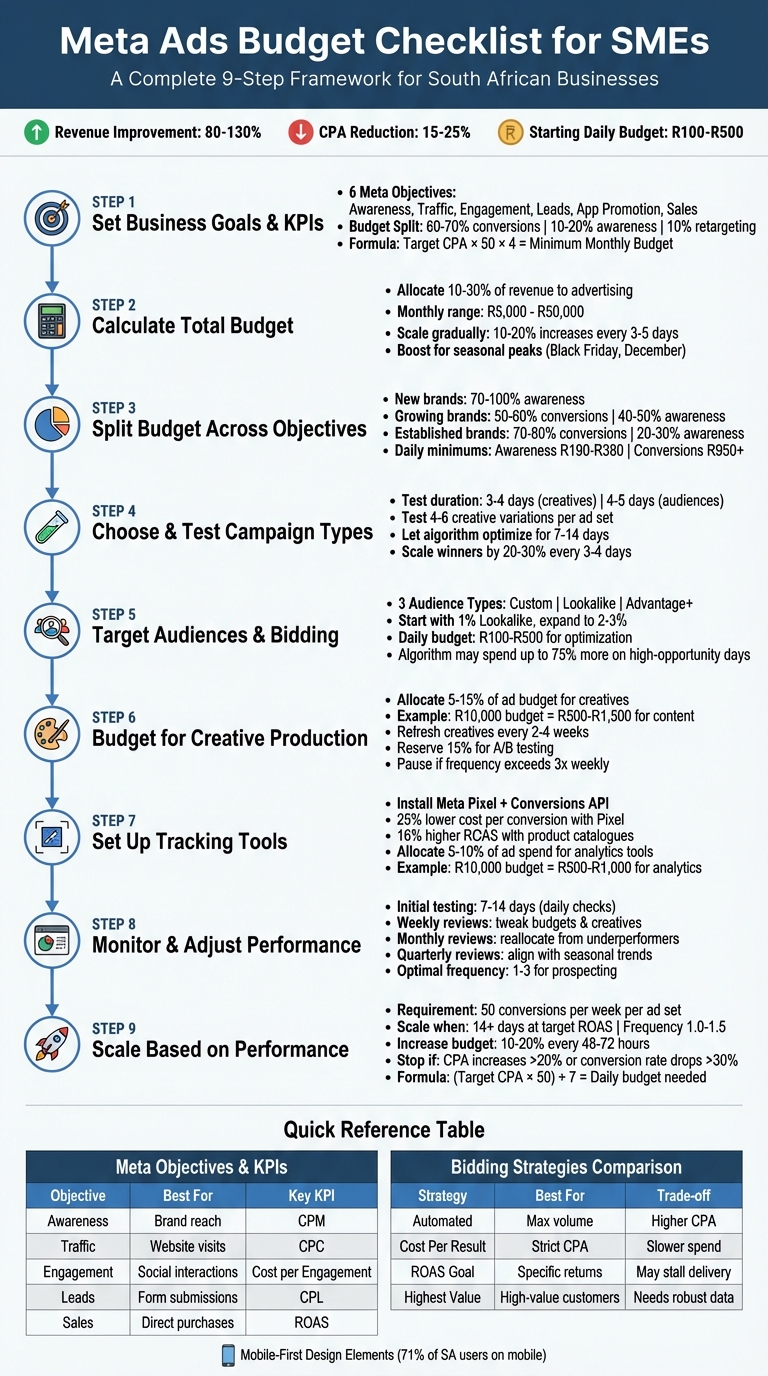
Meta Ads Budget Planning: 9-Step Checklist for SMEs
The Perfect Meta Ads Budget Strategy (Free Calculator & Training)
Step 1: Set Your Business Goals and KPIs
Before you spend a single Rand on Meta Ads, it’s crucial to define what success looks like for your campaign. Your chosen objective not only determines how your budget is spent but also influences how Meta delivers your ads. For instance, selecting "Awareness" pushes Meta to prioritise reaching as many people as possible, while choosing "Engagement" prompts the algorithm to focus on users who are likely to interact with your content.
Identify Your Objectives
Meta provides six main campaign objectives: Awareness, Traffic, Engagement, Leads, App Promotion, and Sales. The objective you pick should match your business’s current goals and stage of growth. For new brands, focusing on Engagement or Awareness can help build an audience that eventually converts at a lower cost.
Take Sydney So Sweet, a children’s clothing retailer, as an example. In September 2024, CEO Jen Greenlees realised that focusing solely on the "Sales" objective was limiting. By shifting to "Engagement", the company significantly grew its Facebook following and later saw better results from conversion ads than when they had targeted sales directly.
"As a store owner, it’s easy to get caught up focusing on sales as your only goal, but by increasing our overall engagement on Facebook, we have actually seen a greater return on our conversion ads." – Jen Greenlees, CEO, Sydney So Sweet
When allocating your ad budget, consider this breakdown: dedicate 60–70% to conversion-based prospecting, 10–20% to non-conversion prospecting, and 10% to retargeting.
Once your objectives are clear, the next step is to define measurable KPIs that will help you track progress.
Set Measurable KPIs
After deciding on your campaign objective, establish KPIs to measure success. For Lead Generation campaigns, track metrics like CPL (Cost per Lead) and lead quality. For Sales campaigns, focus on ROAS (Return on Ad Spend) and Cost per Purchase. If you’re running Awareness campaigns, monitor metrics such as Reach and Frequency. These figures will help you gauge whether your budget is being spent effectively or if adjustments are needed.
To figure out your minimum monthly budget, use this formula: Target Cost Per Acquisition × 50 × 4. For example, if your target CPL is R100, you’ll need a budget of at least R20,000 per month (R100 × 50 × 4) to provide the algorithm with enough data to optimise.
Here’s a quick guide to objectives, their purposes, and the key KPIs to track:
| Meta Objective | Best For | Key KPI |
|---|---|---|
| Awareness | Maximising reach and brand recall | CPM (Cost per 1,000 impressions) |
| Traffic | Driving visitors to a website or blog | CPC (Cost per Click) |
| Engagement | Increasing likes, comments, and shares | Cost per Engagement |
| Leads | Collecting customer info via forms | CPL (Cost per Lead) |
| Sales | Driving direct purchases or catalogue sales | ROAS (Return on Ad Spend) |
Step 2: Calculate Your Total Budget
Once you’ve set clear goals and KPIs, the next step is to determine your Meta Ads budget. This should align with your revenue, the growth stage of your business, and the competitive landscape in South Africa. Striking the right balance ensures you’re not overspending or underfunding campaigns, giving them enough room to deliver meaningful results. A well-thought-out budget sets the stage for smart fund allocation in the steps that follow.
Budget Based on Revenue
A good rule of thumb is to allocate between 10% and 30% of your revenue to advertising. Ezra Firestone, Founder of Smart Marketer, explains the importance of consistent spending:
"Investing between 10% and 30% of your store’s revenue… is one of those things where you’ve got to be willing to consistently spend over time".
For businesses in South Africa, this translates to monthly budgets ranging from R5,000 to R50,000.
If you’re launching a new brand, you might dedicate up to 100% of your budget to brand awareness initially. Over time, as your business grows, you can adopt a more balanced strategy. For example:
- Medium-sized businesses often allocate 60% to performance campaigns and 40% to brand awareness.
- Larger businesses tend to focus more on conversions, with 70% going to performance campaigns and 30% to awareness.
When starting out, aim for a daily spend of R100–R500. Once your campaigns stabilise after 3–5 days, consider increasing your spend by 10–20%. To estimate your daily budget, you can use this formula:
Daily Budget = (Target Audience Size × Average CPC) / Desired Conversion Rate.
Plan for Seasonal Trends
Seasonal events like Black Friday, the December festive season, and Mother’s Day often bring spikes in demand. Adjust your budget during these periods to stay competitive and capitalise on the increased traffic. For instance, if your typical monthly spend is R10,000, you might raise it to R15,000 or R20,000 during November and December to maximise your reach.
Meta’s Budget Scheduling tool makes it easy to plan for these seasonal boosts. It allows your campaigns to scale automatically during high-traffic periods, ensuring you don’t miss out on opportunities.
Before scaling up during these peak times, double-check that your Meta Pixel and Conversions API (CAPI) are properly installed. This ensures you’re tracking performance accurately and not wasting your budget.
Step 3: Split Budget Across Campaign Objectives
Now that you’ve got your total budget sorted, the next step is to divide it thoughtfully across your campaign objectives. This isn’t about splitting your funds equally – it’s about aligning your spend with your business goals and growth stage. Every rand should serve a purpose, whether it’s driving immediate sales or building your brand for the future. A well-planned split can help you balance short-term wins with long-term growth while giving Meta’s algorithm the data it needs to work effectively.
Recommended Budget Splits
Your budget allocation should reflect where your business currently stands. For newer brands, focus heavily on awareness campaigns – allocate 70–100% of your budget to getting your name out there before prioritising conversions. As one Paid Social Account Manager at ASK BOSCO aptly puts it:
"You can’t drive sales if no one knows who you are".
Once your brand has gained some traction, shift your focus. A good rule of thumb is to allocate 50–60% of your budget to conversion campaigns and 40–50% to awareness and retention efforts. Larger, more established businesses tend to go even further, committing 70–80% to revenue-driving conversions and keeping just 20–30% for brand-building efforts.
Another effective approach is the 50/30/20 rule: dedicate 50% of your budget to testing creatives and audiences, 30% to scaling top-performing ads, and 20% to retargeting. This method ensures you’re constantly learning while doubling down on what works best.
Different objectives also require different budget levels. For instance, awareness campaigns can run effectively on R190–R380 per day, while conversion campaigns typically need at least R950 per day to gather enough data for optimisation.
Local Market Adjustments
When operating in South Africa, it’s essential to tailor your strategy to the local market. With mobile usage dominating the landscape, prioritise vertical video formats like Reels and Stories over desktop placements. This often means allocating more budget to engagement-driven objectives that perform well on mobile platforms.
Billing in ZAR is another smart move to avoid any surprises from exchange rate fluctuations. If your monthly budget is on the smaller side – say R2,000 to R5,000 – consider narrowing your focus with geo-targeting. For example, targeting high-conversion areas like Gauteng or the Western Cape can make your budget stretch further.
Keep in mind that different industries face varying levels of competition. For sectors like legal services or insurance, where costs per acquisition tend to be higher, you might want to allocate more of your budget to retargeting. This strategy helps you convert users who are already familiar with your brand, making every rand count.
Step 4: Choose and Test Campaign Types
Now that your budget is sorted, it’s time to pick campaign types and formats that match your goals. Meta provides six main objectives: Awareness, Traffic, Engagement, Leads, App Promotion, and Sales. The trick is to align your campaign objective with your desired outcome – like optimising for purchases if sales are your priority, instead of just aiming for link clicks. This choice sets the foundation for testing, which we’ll dive into next.
Campaign Types and Formats
Your campaign structure should have a mix of prospecting (to find new audiences) and remarketing (to re-engage people who’ve interacted with your brand before). Ads that use videos or carousels tend to generate higher engagement and conversions compared to static images. For retargeting, dynamic ads are a great option since they show users products they’ve already viewed.
It’s also worth testing objectives beyond just sales. Campaigns focused on engagement or awareness can help build a more receptive audience that’s likely to convert later on.
Testing Approach
Start small with your test budget – it’s better to identify what works before scaling up. For creative testing, run experiments for 3–4 days. When testing audiences, extend that to 4–5 days, but only change one variable at a time. Test 4–6 different creative variations within each ad set, using a mix of images, videos, and copy. Savannah Sanchez, Founder of The Social Savannah, highlights the importance of this approach:
"I believe that having a volume of effective ad creatives is the only way to scale an ad account. It’s not about any media buying hacks or crazy tactics. It all boils down to doing weekly creative testing".
Once your tests are running, let Meta’s algorithm do its thing for 7–14 days before making any big changes. If you find a winning ad, scale it up gradually – bumping the budget by 20–30% every 3–4 days helps avoid disrupting Meta’s learning phase. Keep an eye on ad frequency, and refresh your creatives regularly to prevent audience fatigue.
After fine-tuning your campaigns, you can shift your focus to sharpening targeting and bidding strategies for even better results.
Step 5: Target Audiences and Choose Bidding Strategies
Once your budget is set and campaigns are live, the next step is zeroing in on the right audience and selecting a bidding strategy that aligns with your goals. The goal? Reach the right people while making the most of your ad spend. Striking a balance between precise targeting and a broad enough audience is key to helping Meta’s algorithm work its magic.
Define Your Target Audience
Meta provides three main audience types to help you tailor your campaigns: Custom Audiences, Lookalike Audiences, and Advantage+ Audiences.
- Custom Audiences are built using your existing customer data.
- Lookalike Audiences help you find new customers similar to your best ones.
- Advantage+ Audiences leverage AI to target people based on their past interactions with your brand.
You can refine these audiences further by location (e.g., targeting Johannesburg or Cape Town), demographics (like age, gender, education, or income), interests (hobbies, preferences), and behaviours (such as shopping patterns or device usage). While it’s tempting to go super-specific, it’s often better to start broader. A larger audience gives Meta’s algorithm enough data to learn effectively during the early stages. Lookalike Audiences are particularly effective – start with a 1% similarity for the closest match to your source data, then expand to 2–3% as you gather performance insights.
"The biggest risk on Meta is wasting ad dollars if you don’t know what you’re doing. Teaching yourself will cost some money before you see a return."
- Nina Dans, Director of Paid Social at Socium Media.
Once you’ve nailed down your audience, the next step is choosing a bidding strategy that fits your campaign goals.
Select Bidding Strategies
Your bidding strategy determines how Meta spends your budget and prioritises your objectives. Here are some common options to consider:
- Automated Bidding: Focuses on maximising results, prioritising volume over strict cost-per-acquisition (CPA) limits.
- Highest Value Bidding: Directs your budget towards high-value customers. This requires accurate purchase data from your Meta Pixel.
- Cost Per Result Goal: Aims to keep costs at or below a specific amount, ideal if you have strict CPA requirements.
- ROAS Goal: Targets a specific return on ad spend. Be cautious, as delivery can pause if the ROAS target is set too high.
Meta’s algorithm may spend up to 75% more than your daily budget on high-opportunity days, but it balances out over the week. To give the algorithm enough time to stabilise, let your campaigns run for at least two weeks without making major changes.
| Bid Strategy | Best For | Trade-off |
|---|---|---|
| Automated Bidding | Maximising volume and spending full budget | May result in higher CPA compared to manual controls |
| Cost Per Result Goal | Maintaining a strict CPA | Slower spend; longer learning phase |
| ROAS Goal | Achieving a specific return on ad spend | Delivery may stall if ROAS floor is too high |
| Highest Value | Focusing on high-value customers | Requires robust pixel data and varied product values |
For South African small businesses, a starting daily budget of R100 to R500 typically provides enough data for Meta’s algorithm to optimise effectively. In the beginning, it’s a good idea to use Advantage+ Placements, which allow Meta to decide where your ads perform best across Facebook, Instagram, and Messenger. Once you’ve gathered enough data, you can switch to manual placements to fine-tune your strategy.
If you’re looking for expert advice on how to refine your Meta Ads campaigns, Aion Marketing can help craft strategies tailored to your business needs.
sbb-itb-6f8605a
Step 6: Budget for Creative Production and Updates
When planning your Meta Ads budget, it’s crucial to remember that you’re not just paying for clicks and impressions. A portion of your funds should be earmarked for creating and refreshing the content your audience engages with. Without eye-catching visuals and compelling copy, even the best targeting can fall flat. Fortunately, AI tools now make producing high-quality creatives more affordable and efficient. Let’s look at how to allocate your budget for these essential assets.
Creative Production Budget
In addition to your ad spend, you’ll need to allocate funds specifically for creative production. A good rule of thumb is to set aside 5–15% of your Meta Ads budget for this purpose. This includes everything from videos and images to ad copy and product photography. For instance, if your monthly Meta Ads budget is R10,000, you should plan to spend between R500 and R1,500 on creating and updating your content. Some experts even suggest reinvesting 10–30% of your store’s total revenue into advertising, which covers both ad spend and creative costs.
The cost of producing creative content varies depending on its complexity. For example, creating high-quality videos or detailed infographics will typically require more resources than simpler text-based posts. If a professional studio isn’t always within reach, you can turn to mobile apps like Ripl, Videoshop, and Legend, or use Meta’s Creative Hub to produce cost-effective ad creatives.
AI tools are also transforming the way creatives are made. Andrew Faris, Founder of AJF Growth, highlights this shift:
"AI is just making a lot of things cheaper… The most obvious one of them is the cost of creative production".
With AI, you can generate ad scripts or create AI-voiced explainer videos, allowing you to scale your campaigns without significantly increasing your creative budget. Premium AI tools, costing around R3,600 per month (roughly $200), can also handle tasks like customer research and scriptwriting, saving you both time and money.
Creative Update Schedule
Creating great content is only half the battle – keeping it fresh is equally important. Even the most engaging ad creatives lose their effectiveness over time. Audiences can become fatigued when they see the same visuals too often, so refreshing your creatives every 2–4 weeks is a smart strategy. Hector Gutierrez, CEO of JOI, explains:
"People get burnt out when they constantly see the same ads. Create a collection of ads for the same campaign and change the images and colours used on a single offer to boost engagement".
To keep things fresh, allocate about 15% of your budget for A/B testing and regular updates. Monitor your ad frequency and click-through rates – if frequency exceeds three times weekly or click-through rates start to drop, it’s time to refresh your creatives. Begin with a modest daily budget of around R300 (approximately $20) to test multiple ad variations before scaling.
Do note that updating your creatives can trigger Meta’s "Learning" phase, where the algorithm gathers data to optimise ad delivery. This phase usually requires about 50 conversions per week to complete successfully. For this reason, it’s best to let ads run for at least two weeks before deciding whether to refresh or scale.
If managing creative production and updates feels overwhelming, consider reaching out to Aion Marketing. They offer Meta Ads management and content creation services tailored for South African businesses, helping you stay ahead in the competitive digital landscape.
Step 7: Set Up Tracking and Attribution Tools
Once you’ve allocated your budget for creatives and ad spend, the next step is to ensure you have precise tracking and attribution in place. Without these tools, it’s almost impossible to tell which campaigns are boosting sales and which are just eating into your budget. This step ties directly into your overall Meta Ads strategy, helping you make informed decisions.
Install Meta Pixel and Conversions API
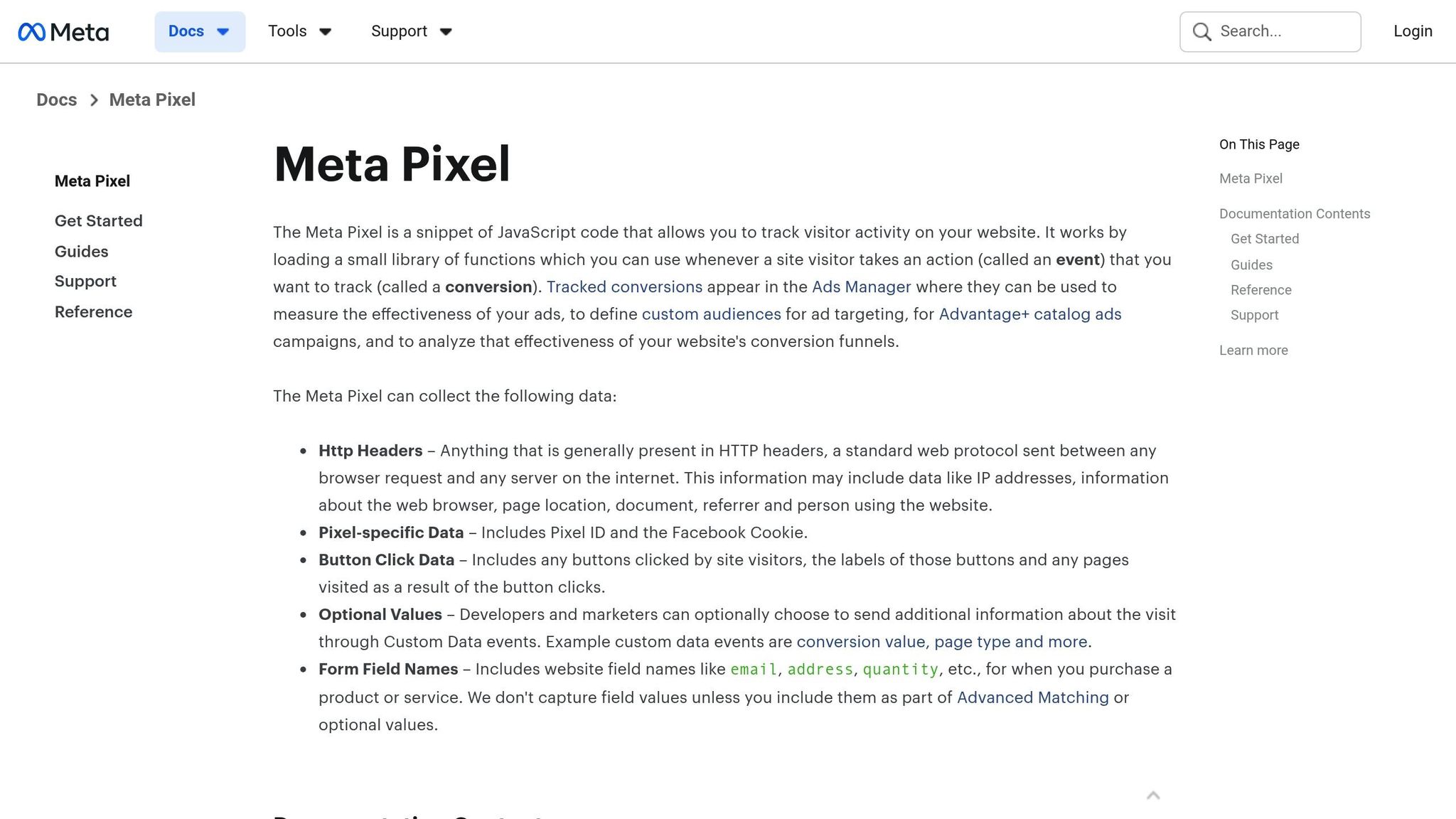
Start by installing the Meta Pixel – a small JavaScript code that tracks actions on your site, such as page views, purchases, and form submissions, and sends this data to Meta for optimisation. Businesses using the Meta Pixel often experience a 25% lower cost per conversion, while product catalogue campaigns can see a 16% higher return on ad spend.
For a more comprehensive setup, pair the Meta Pixel with the Conversions API (CAPI). Unlike the Pixel, which works through the browser, CAPI operates server-side, bypassing browser restrictions like ad blockers and cookie limitations. This dual setup ensures you capture more conversion data, even when users have strict privacy settings enabled.
Platforms like Shopify, WordPress, or Google Tag Manager make it easy to set up both tools with a one-click "Partner Integration" – no coding required. To improve attribution accuracy, enable Advanced Matching through the Events Manager. This feature helps Meta better identify your website visitors, ensuring more reliable data.
Meta supports 17 standard events (like Purchase, Lead, and Add to Cart) that align with common business goals. You can also create up to 100 custom conversions to track actions specific to your business. During the early stages of your campaign, monitor your conversion data daily and conduct a full strategy review every quarter to ensure your tracking setup remains accurate.
Budget for Analytics Tools
Once your tracking tools are running smoothly, consider setting aside a portion of your ad budget for advanced analytics tools. Experts recommend allocating 5–10% of your ad spend for this purpose. For instance, Google Analytics 4 (GA4) offers a free tier that helps you track critical metrics like Lifetime Value (LTV) and Customer Acquisition Cost (CAC) – key indicators of whether your campaigns are delivering long-term profitability.
For South African small and medium-sized enterprises (SMEs), if you’re spending R10,000 per month on Meta Ads, reserve R500 to R1,000 for analytics tools and technical support. This budget can cover premium features, integration help, or compliance checks to ensure your data collection aligns with the Protection of Personal Information Act (POPIA). With over 71% of South Africans accessing the internet via mobile devices, it’s crucial to optimise your tracking for mobile users to get accurate attribution data.
If configuring these tools feels like a daunting task, you can turn to experts like Aion Marketing (https://aionmarketing.co.za). They specialise in Meta Ads management and can ensure your Meta Pixel and Conversions API are properly set up, so you don’t miss out on any conversions. This way, you’ll be equipped to make data-driven decisions right from the start, aligning with the expert advice laid out in this checklist.
Step 8: Monitor and Adjust Campaign Performance
Now that your tracking tools are set up, it’s time to focus on keeping a close eye on your campaigns. Regular monitoring is key to spotting performance shifts and making informed adjustments. Give Meta enough time to optimise your campaigns, but stay ready to take advantage of what’s working.
Initial Testing Period
In the first 1–2 weeks after launching a campaign, check your Ads Manager daily. The algorithm typically needs 7–14 days to collect data and optimise delivery, so avoid making big changes too soon unless performance takes a major turn. During this period, fluctuations are normal, and patience is crucial.
Keep an eye on metrics that align with your campaign goals. For example:
- Traffic campaigns: Look at Link Clicks, CPC (Cost Per Click), and CTR (Click-Through Rate).
- Conversion campaigns: Focus on CPL (Cost Per Lead), CPA (Cost Per Acquisition), and ROAS (Return on Ad Spend).
If your CPL starts climbing, use this formula to check if it’s still within your margins: Marketing Spend ÷ Number of Leads Earned. Also, monitor ad frequency – if it goes above 1–3 for prospecting campaigns, your audience might be seeing the same ad too often, which can cause ad fatigue.
"Meta changes continuously and without warning, so that’s why it is highly advisable to have a person or agency monitoring the platform at all times." – Nina Dans, Director of Paid Social, Socium Media
Once the initial data is in, you can begin refining your approach with regular reviews.
Monthly and Quarterly Reviews
After the testing phase, ongoing reviews will help you keep your campaigns on track. Conduct weekly reviews to tweak budgets and refresh creatives. Every month, reallocate budgets from underperforming ad sets, and every quarter, align your strategy with seasonal trends.
Use the "Breakdown" tab in Ads Manager to identify which placements, age groups, or locations are delivering the best results. Then, shift your budget to focus on those areas. For South African businesses, it’s smart to plan quarterly reviews around key shopping periods like Black Friday in November, the December festive season, or back-to-school sales in January. Adjust your budgets ahead of these peak times to capture the increased traffic.
When scaling a successful campaign, increase the budget gradually – around 20–30% every 3–4 days – to maintain stability. You can also set automated rules in Ads Manager to pause ads that exceed your daily budget or fall below your target ROAS. This reduces the need for constant manual monitoring.
If managing all this feels like too much, consider working with Aion Marketing (https://aionmarketing.co.za). Their team specialises in Meta Ads management, tracking campaigns and making data-driven adjustments to help you maximise your ROI – so you can focus on running your business.
Step 9: Scale Campaigns Based on Performance
Now that you’ve been consistently monitoring your campaign performance, it’s time to scale – but tread carefully. Scaling too quickly can disrupt the algorithm and waste your budget. The key here is to increase your spending gradually, focusing on campaigns that show consistent success.
Increase Budget for Top Performers
Before increasing your budget, ensure your campaigns are truly ready. Meta’s algorithm requires 50 conversions per week per ad set to exit the "learning phase" and function optimally. Scaling prematurely can reset the algorithm, leading to inefficiencies.
Look for campaigns that have hit your target ROAS for at least 14 consecutive days. These campaigns should also show stable or decreasing CPA and maintain a frequency between 1.0 and 1.5. If frequency exceeds 3.0, scaling could backfire and should be paused.
Once ready, increase your budget incrementally – by 10–20% – every 48–72 hours. For example, if your current daily spend is R500, raise it to R600 after three days, and then to R720 a few days later. This gradual approach helps prevent the algorithm from re-entering the learning phase.
"Scaling Meta ads is a delicate dance. Increase your budget too quickly, and you can throw the algorithm into a frenzy, triggering the ‘learning phase’ again and potentially burning your audience." – Conor Dargle, GeistM
You can also scale horizontally by duplicating successful ad sets and testing them with new Lookalike Audiences. Start with 1% Lookalike Audiences and gradually expand to 3–10%. Regularly update your creatives to keep your audience engaged and prevent fatigue.
For example, if your target CPA is R100, you’ll need a daily budget of approximately R714 to hit the 50-conversions-per-week threshold. Use this formula: (R100 × 50) ÷ 7 ≈ R714.
If you notice your CPA increasing by more than 20% over seven days or your conversion rate dropping by over 30%, it’s time to scale back. Similarly, if audience saturation exceeds 80%, further scaling could become risky.
Get Professional Support
Scaling campaigns can be a complex and time-consuming process, especially for small to medium-sized businesses. If managing Meta Ads on top of your daily operations becomes overwhelming, consider bringing in professional help.
For South African businesses, Aion Marketing (https://aionmarketing.co.za) offers specialised Meta Ads management. They handle everything from budget adjustments and audience targeting to creative testing and performance analysis. With their expertise, you can scale your campaigns without compromising algorithm stability or ROI. This allows you to focus on running your business while they optimise your ad performance – a strategic move for ensuring your budget delivers maximum results.
Conclusion
Building a Meta Ads budget that works effectively calls for a clear, results-driven strategy. Start by defining your business objectives and KPIs, then calculate your budget based on revenue patterns and seasonal trends. Allocate funds wisely across campaign goals, experiment with various ad formats, and ensure your tracking tools are fully operational before launching. Keep a close eye on performance daily and scale carefully to maximise returns without overspending. These steps, outlined earlier, are essential for keeping your strategy focused on delivering ROI.
It’s worth noting that hitting 50 conversions per week is key to getting the best performance from your campaigns. Without proper tracking, informed allocation of resources, and regular testing, you’re essentially navigating without a map. This is a common challenge for many SMEs, as they juggle daily operations alongside keeping up with campaign performance, creative updates, and algorithm changes.
If managing all of this feels overwhelming, seeking professional help can be a game-changer. Aion Marketing (https://aionmarketing.co.za) offers Meta-certified expertise, handling everything from budget optimisation and audience targeting to creative testing and performance analysis. Their clients typically see an average revenue increase of 80% and a CPA reduction of 50%, delivering measurable results for South African businesses.
Ultimately, your Meta Ads budget is an investment in fueling business growth through digital channels. Treat it as such by planning thoughtfully, monitoring performance closely, and scaling campaigns strategically. Whether you manage your ads in-house or enlist expert assistance, following these principles will help you make the most of every rand and drive meaningful growth.
FAQs
How do I set the right budget for my Meta Ads campaigns?
To plan an effective budget for your Meta Ads campaigns, start by outlining clear objectives. Whether your aim is to boost website visits, generate leads, or drive sales, having a focused goal will guide your spending strategy.
A practical approach is to allocate 70% of your budget to prospecting, which targets new audiences, and the remaining 30% to retargeting, aimed at re-engaging users who have already interacted with your brand.
Kick things off with a modest daily budget that aligns with the size of your business. Keep a close eye on critical metrics like Cost Per Acquisition (CPA) and Return on Ad Spend (ROAS) to gauge performance. If you notice positive trends, you can gradually increase your investment to amplify results. For those needing extra guidance, professionals like Aion Marketing are well-versed in tailoring Meta Ads strategies to the South African market.
How should I allocate my Meta Ads budget to meet different campaign goals?
To make the most of your Meta Ads budget, start by defining your main campaign objectives. These could include brand awareness, driving website traffic, generating leads, or boosting direct sales. Once you’ve prioritised these goals, allocate your budget accordingly. For example, a small e-commerce store might dedicate 60% to driving traffic, 30% to lead generation, and 10% to building brand awareness when launching a new product.
For South African SMEs, the 70/30 rule is a practical guideline. This means using about 70% of your monthly budget for prospecting campaigns to attract new customers and 30% for retargeting ads to re-engage users who’ve already interacted with your brand. If your monthly budget is R20,000, for instance, you might spend R14,000 on prospecting and R6,000 on retargeting.
To get better results, take advantage of Meta’s Campaign Budget Optimisation (CBO) tool. This feature automatically shifts your budget towards ads that are performing well. Keep an eye on key performance metrics like click-through rate (CTR), cost per acquisition (CPA), and return on ad spend (ROAS) to fine-tune your strategy and improve performance. If you’re looking for expert help, Aion Marketing offers customised Meta Ads management services to help South African businesses achieve the best possible ROI.
How often should I refresh my Meta ad creatives to keep my audience engaged?
To keep your audience interested and avoid ad fatigue, it’s smart to update your Meta ad creatives every 3 to 7 days. Regular updates keep your content appealing and relevant, which can help maintain engagement and improve your ad performance.
Pay close attention to campaign metrics like click-through rates (CTR) and engagement levels. These numbers can reveal when your audience might be losing interest. Use this data to fine-tune how often you refresh your ads, ensuring they resonate with your specific audience and deliver the best results.


