


Content marketing can drive growth for SMEs, but only if you track the right metrics. Without measuring performance, you’re flying blind, wasting time and money. Here’s what you need to focus on:
- Website Traffic: Track users, sessions, and pageviews. Focus on traffic sources (organic, social, direct, etc.) and engaged sessions.
- Engagement: Measure bounce rate, average engagement time, and social media interactions like shares and comments.
- Lead Generation: Monitor lead volume, qualification rates, and cost per lead (CPL) to assess efficiency.
- Conversions: Evaluate landing page, email, and sales conversion rates, plus micro-conversions like sign-ups and downloads.
- Search Rankings: Use keyword rankings, organic traffic, and click-through rates (CTR) to boost visibility.
- Brand Awareness: Track reach, impressions, and brand mentions to understand your visibility and audience growth.
- Customer Retention: Measure Customer Lifetime Value (CLV) and Repeat Purchase Rate (RPR) to keep customers engaged.
- Return on Investment (ROI): Calculate ROI by linking revenue to content efforts and tracking assisted conversions.
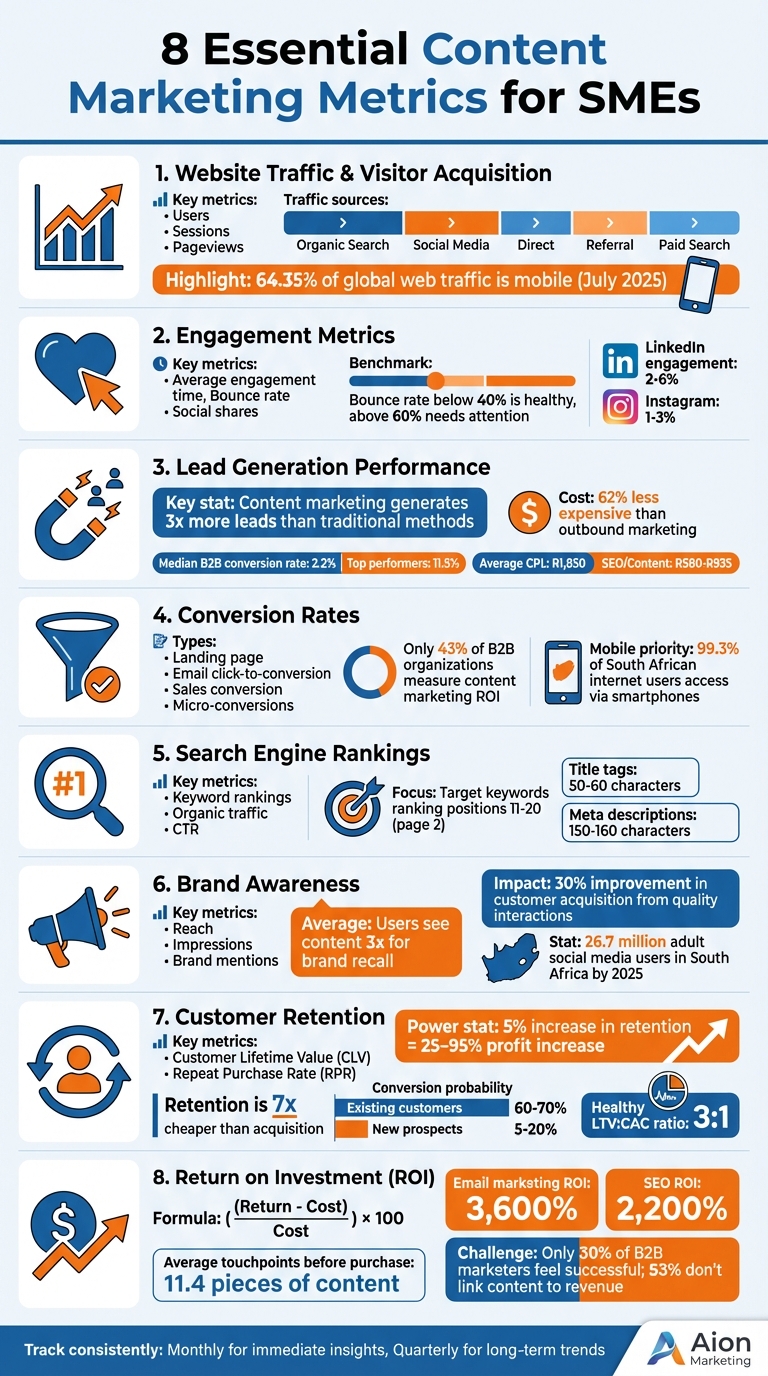
8 Essential Content Marketing Metrics for SMEs
Measuring Success in Content Marketing | Jason Patterson
sbb-itb-6f8605a
1. Website Traffic and Visitor Acquisition
Assessing website traffic is the starting point for understanding the impact of your content marketing efforts. Without visitors, even the most well-crafted content won’t achieve its purpose. For South African SMEs, keeping a close eye on visitor demographics, traffic sources, and behaviour ensures that every rand spent delivers value.
To begin, focus on three key metrics: Users (unique individuals visiting your site), Sessions (total visits, noting that a single user can have multiple sessions), and Pageviews (the total number of times pages are loaded). These numbers provide a snapshot of your reach, but they don’t tell the whole story. As Digital MicroEnterprise puts it:
Traffic by itself is a vanity metric. What truly matters is traffic that contributes to your business goals.
This means it’s not just about how many people visit your site, but whether those visits align with your objectives.
Understanding Traffic Sources
Once you’ve established your baseline metrics, dive into traffic sources to understand where your visitors are coming from. Tools like Google Analytics 4 (GA4) categorise traffic into key channels: Organic Search (unpaid search results), Social Media, Direct (from typed URLs or bookmarks), Referral (links from other websites), and Paid Search. Knowing which channels bring in visitors helps you allocate your marketing budget effectively. Utilizing professional digital marketing services can further refine this allocation.
Pay special attention to engaged sessions, which GA4 defines as visits lasting 10 seconds or longer, involving a conversion, or including at least two pageviews. This metric filters out accidental clicks and bot traffic, offering a clearer picture of genuine audience interaction. Combine this with average engagement time to assess how well your content resonates. For instance, if a detailed 2,000-word article averages only 10 seconds of engagement, it’s a sign that the content might not be meeting visitor expectations.
Tracking and Attribution
To ensure accurate attribution of traffic sources, add UTM parameters to all external links, such as those in social media posts, email campaigns, or downloadable PDFs. This prevents GA4 from lumping traffic into the ambiguous "(direct) / (none)" category. Regularly reviewing this data – ideally on a weekly basis – helps you identify trends while avoiding knee-jerk reactions to normal fluctuations.
Finally, with mobile devices making up 64.35% of global web traffic as of July 2025, it’s essential to monitor mobile performance separately from desktop. This ensures your site delivers a seamless experience across all devices, helping you retain and engage visitors effectively.
2. Engagement Metrics
Once you’ve analysed your website traffic, the next step is to dive into engagement metrics. These metrics tell you whether visitors are genuinely interested in your content. While traffic numbers show how many people land on your site, engagement metrics reveal if your content is holding their attention and providing something worthwhile.
One key metric to watch is average engagement time. This GA4 feature replaces session duration and measures how long users actively interact with your content. It’s a good indicator of how "sticky" your content is – whether it keeps people reading, watching, or exploring, or if they leave quickly. Cecilia Meis, Senior Editor and Strategist at Semrush, emphasises the value of tracking content performance:
Tracking content performance is important because it shows marketers which activities are working and which need improvement. This insight helps marketing teams optimise tactics, justify resource allocation, and gain support for future ideas.
Another critical metric is bounce rate, which acts as a barometer for how well your content matches audience expectations. In GA4, a session is considered a "bounce" if it lasts under 10 seconds, includes only one page view, or results in no conversions. A bounce rate below 40% is typically seen as healthy, while anything above 60% suggests potential issues. If you notice high bounce rates paired with low engagement time, it might mean your content isn’t delivering what users expected. This could be due to misleading meta descriptions or weak internal linking. To address this, audit pages with high bounce rates and add links to related content that could keep users engaged.
On social media, engagement rate gives more context to how your audience interacts with your posts. Calculated as total interactions divided by total audience, this metric helps you measure the quality of your content. Engagement rate benchmarks differ by platform – LinkedIn averages 2–6%, while Instagram falls between 1–3%. Among engagement actions, shares are particularly valuable because they indicate your content resonates deeply enough for someone to recommend it, which also boosts its visibility in algorithms. Freelance social media marketer Rebecca Broad summarises it well:
Keeping engagement rate in mind means I constantly assess visuals and copy and ask ‘why would anyone care?’.
Comments, meanwhile, offer rich qualitative insights. They can highlight pain points, product ideas, or general sentiment that numbers alone can’t capture.
To improve engagement across platforms, try using visuals and videos to make your content more dynamic. In GA4, track scroll depth to identify where users lose interest, and experiment with different formats if engagement starts to dip. Meryoli Arias, Head of Social Media at Glide, advises against chasing viral moments:
I learned that virality is not and should never be the goal of social media. A good tap in the shoulder for the ego does not equal business success.
Instead, aim for meaningful interactions that guide users closer to taking action, whether that’s subscribing, purchasing, or reaching out.
3. Lead Generation Performance
Once you’ve captured interest, the next step is assessing whether that interest translates into quality leads. This is where lead generation performance comes into play. It’s not just about getting views – it’s about gauging whether people are willing to share their contact details or take meaningful actions that bring them closer to becoming customers. The goal? Turn engagement into actionable leads.
Start by monitoring your total lead volume – the number of people signing up for newsletters, downloading resources, requesting demos, or completing contact forms. Content marketing is a powerhouse in this area, generating three times as many leads as traditional outbound methods while costing 62% less. This makes it particularly appealing for SMEs working with tight budgets. But sheer numbers only tell part of the story. Experts like Nichole Elizabeth DeMeré and Perryn Olson highlight that content should act as a filter, helping you attract the right audience while screening out unqualified prospects. So, it’s crucial to evaluate both the quantity and the quality of your leads.
To dig deeper, track your lead qualification rate – the percentage of leads that meet the criteria to be considered Marketing Qualified Leads (MQLs) or Sales Qualified Leads (SQLs). For context, the median conversion rate for B2B content sits at 2.2%, but top-performing landing pages can achieve rates as high as 11.5%. Collaborate with your sales team to audit leads and ensure they meet the necessary qualifications.
Another key metric is cost per lead (CPL), which shows how financially efficient your content efforts are. You can calculate it by dividing your total marketing spend by the number of leads generated. On average, CPL across marketing firms is around R1,850.00, though this varies by industry and channel. SEO and content marketing often provide the most cost-effective CPL, ranging between R580.00 and R935.00, compared to LinkedIn ads, which can cost upwards of R1,400.00–R1,870.00+. For South African SMEs, tracking CPL is invaluable for comparing the long-term benefits of organic content with the recurring expenses of paid campaigns.
Don’t forget about assisted conversions. Around 40% to 60% of B2B conversions involve multiple touchpoints rather than a single direct click. Tools like Google Analytics or your CRM can help you identify which blog posts or resources users interacted with along their journey, even if those weren’t the final steps before converting. To maximise these opportunities, attach a relevant lead magnet – such as a checklist, template, or industry report – to high-traffic posts. If readers aren’t downloading your lead magnet or signing up, it could mean the content is drawing the wrong audience or that the offer isn’t compelling enough.
4. Conversion Rates
Once you’ve turned engagement into leads, the next step is measuring conversion rates to see how many of those leads actually become customers. A conversion rate shows the percentage of visitors who complete a specific action – whether that’s making a purchase, signing up for a newsletter, downloading a resource, or booking a demo.
There are several types of conversion rates worth keeping an eye on. For example, your landing page conversion rate reveals how effective your pages are at prompting actions like form submissions or demo requests. The email click-to-conversion rate tracks how many users click a link in your email and then take an important action on your site. Meanwhile, the sales conversion rate (or e-commerce conversion rate) measures the ratio of completed transactions to overall website visits. Don’t overlook micro-conversions either – actions like newsletter sign-ups, content downloads, or social media interactions. These smaller steps indicate interest and help nudge prospects closer to becoming customers.
Interestingly, only 43% of B2B organisations measure content marketing ROI, even though 65% have specific KPIs in place. That’s a huge missed opportunity. Tools like Google Analytics can help you bridge this gap by setting up goal funnels that map out the customer journey and highlight where potential customers are dropping off. For South African SMEs, optimising for mobile is non-negotiable – 99.3% of internet users in South Africa access the web via smartphones. This makes mobile-first strategies essential for improving conversion funnels.
Boosting conversion rates doesn’t mean starting from scratch. Simple tweaks can make a big difference. Start by A/B testing high-traffic pages. Experiment with elements like call-to-action button colours, headline wording, or the placement of key information. Another smart move is tackling content decay – identify posts that have lost 20% or more of their traffic over the last three to six months. Refresh these posts with updated stats, new internal links, or fresh insights to restore their performance.
"If you improve a post that’s pulling in 5,000 visitors per month by just 1%, you’ll see a much higher ROI than if you improve a mediocre post doing 100 visitors per month by 10%".
Focus your efforts on areas with the greatest potential for impact.
Don’t forget the basics. Make sure your pages are easy to navigate with clear subheadings, short paragraphs, and readable fonts. Use your analytics tools to track which content drives conversions. Remember, less than 45% of websites manage to keep visitors engaged for an average session of two to three minutes. If your visitors aren’t sticking around, they’re unlikely to convert. Small improvements to the user experience – like faster load times or clearer layouts – can make a noticeable difference. By improving these conversion rates, you’ll see a direct boost in your content marketing ROI, making every effort count.
5. Search Engine Ranking Performance
Search engine ranking performance is all about measuring how easily your content can be found online. Three key metrics take centre stage here: keyword rankings, organic traffic, and click-through rates (CTR).
Keyword rankings indicate where your pages show up in search results for specific terms. This is crucial because if your content lands beyond the first page, it’s almost like it doesn’t exist – users rarely click that far.
Organic traffic, which refers to unpaid visits from search engines, is a dependable way for South African SMEs to attract an audience. Unlike paid ads that stop delivering the moment you cut spending, organic traffic builds momentum over time. To make the most of it, you need to identify which keywords drive this traffic and confirm they match your audience’s needs. If your pages are getting high impressions but low CTR, it’s a sign: your content might be visible, but it’s not convincing enough to earn clicks. This highlights the importance of pairing relevant search terms with enticing metadata .
"Improvements in CTR can drive significant traffic increases without changing rankings, making it one of the most efficient optimisation opportunities." – Nathan Wahl, Animalz
A smart strategy is to focus on "striking distance" keywords – those ranking between positions 11 and 20 (page 2). These are opportunities waiting to be tapped. Following an SEO checklist to update old stats, improve internal linking, or polish metadata can push these pages onto the first page, where they’ll gain much more visibility. For metadata, keep title tags between 50 and 60 characters and meta descriptions between 150 and 160 characters to ensure they appear fully in search results.
Another trend to watch is the rise of AI-driven search results. For example, Wikipedia saw an 8% drop in traffic in 2024 due to AI tools providing direct answers on search pages. This means traditional ranking metrics alone aren’t enough anymore – you also need to track actual clicks.
To do this, tools like Google Search Console are a great starting point and won’t cost you a cent. For more in-depth insights, consider paid tools like Moz (starting at $99/month), Semrush (from $130/month), or Ahrefs (from $100/month). If you’re running an SME with a tight budget, the best approach is to start with free tools and gradually explore paid options as your business grows.
6. Brand Awareness Metrics
Once you’ve examined engagement and conversion metrics, it’s time to evaluate how well your brand is making an impression. Key metrics like reach, impressions, and brand mentions are essential for understanding visibility, building trust, and ultimately driving sales.
Reach reflects the number of unique users who see your content, while impressions show the total number of times your content is displayed. On average, users see the same content about three times, which helps reinforce brand recall.
Tracking brand mentions gives you insight into how often your brand is discussed online. Pair this with monitoring follower growth with social media management to confirm whether you’re expanding your audience. But it’s not just about numbers – quality interactions, like comments and shares from engaged followers, carry more weight. These meaningful connections can lead to a 30% improvement in customer acquisition. With South Africa projected to have 26.7 million adult social media users by 2025, even a small increase in mentions can signal growing awareness. The tone of these mentions matters too; positive feedback builds trust, while negative comments can highlight areas that need attention.
"Brands must navigate wisely between immediate gains and sustainable growth." – Irina Vlad, Managing Director at Ivie Media
To stay on top of these metrics, tools like Meta Business Suite offer valuable insights for platforms like Facebook and Instagram. Regularly review your monthly reach and impressions to identify which content resonates most. For tracking brand mentions, tools like Google Alerts or social listening platforms can provide actionable feedback. Focus on mobile-first strategies, consistent posting, and quick responses to audience interactions. These efforts not only keep your brand visible in algorithms but also foster a loyal community. Together, these metrics help refine and strengthen your content strategy.
7. Customer Retention Through Content
Turning leads into customers is one thing, but keeping those customers coming back is where the real profit lies. Customer retention is a powerful driver of long-term success, and metrics like Customer Lifetime Value (CLV) help quantify just how much revenue a customer brings in over their relationship with your business. Here’s a compelling stat: boosting retention rates by just 5% can increase profits by anywhere from 25% to 95%. Not to mention, retaining a customer is far more cost-effective – up to 7 times cheaper – than acquiring a new one.
While conversion rates measure immediate wins, retention metrics like CLV and Repeat Purchase Rate (RPR) reveal the bigger picture. For example, a dip in your RPR might signal that your customer engagement efforts need reworking. And when it comes to selling, the odds are in your favour with existing customers – there’s a 60% to 70% chance they’ll buy again, compared to just 5% to 20% for new prospects. To ensure sustainable growth, keep an eye on your LTV:CAC ratio (lifetime value to customer acquisition cost) – a 3:1 ratio is considered a healthy benchmark.
Content plays a pivotal role in keeping customers engaged. Metrics like returning visitor rates can tell you if your content is keeping customers interested. Dive deeper by analysing which pages repeat visitors are drawn to – this can reveal what resonates most after their initial purchase. For email campaigns, track open and click-through rates to understand how well your content answers customer questions or highlights product benefits.
Real-world examples show how effective this can be. The Honest Kitchen saw a fourfold increase in referral opt-ins by using personalised content, while Splash Wines used timely email campaigns to drive a 177% increase in repeat sales. Tactics like onboarding videos, product tutorials, targeted email series, and quick-start guides not only improve engagement but also encourage referrals.
Despite its importance, only 42% of businesses can accurately measure CLV, even though 76% recognise its value. Tools like Google Analytics 4 now make it easier to gain actionable insights by focusing on engaged sessions – defined as sessions lasting 10 seconds or more with at least two page views – rather than outdated metrics like bounce rates. By creating content that solves problems and helps customers get more out of their purchase, you can turn one-time buyers into loyal advocates.
At Aion Marketing, we work with South African SMEs to apply these insights, helping them craft content strategies that not only attract new customers but also build enduring relationships. With these retention strategies in place, the next step is to sharpen your focus on maximising overall ROI.
8. Return on Investment (ROI)
ROI is the ultimate measure of success: is your content marketing actually profitable? The formula is simple:
((Return from Content - Cost of Content) / Cost of Content) * 100.
For instance, if you spent R10,000 on content and earned R30,000 in revenue, your ROI would be 200%. Straightforward maths, right? But, as Ryan Law points out, the real challenge lies in applying this formula accurately in the real world.
The difficulty comes from tracking all costs and correctly attributing revenue. Costs include everything from freelancer fees and software subscriptions to ad spend and a share of your marketing manager’s salary. On the revenue side, direct sales are easier to measure, but content often plays a supporting role. Research shows consumers engage with about 11.4 pieces of content before making a purchase. To address this, tools like Google Analytics 4 offer attribution models that help distribute credit across touchpoints. For example, linear attribution splits credit equally across all interactions, while position-based attribution gives 40% to both the first and last touchpoints, with 20% spread across the rest.
For businesses with longer sales cycles, metrics like Revenue Per Subscriber (RPS) can be helpful. You calculate this by dividing total email-driven sales by the number of subscribers. To refine tracking, set up conversion goals in GA4 with estimated values for actions like demo requests or whitepaper downloads, using historical close rates as a guide. Adding UTM parameters to links in emails, social posts, or guest articles also allows you to pinpoint which content drove traffic and conversions. This level of detail helps you allocate budgets more effectively and adjust strategies as needed.
Consider the numbers: email marketing boasts an average ROI of 3,600%, while SEO delivers about 2,200%. Yet, only 30% of B2B marketers feel their organisations are successful at content marketing, and a surprising 53% don’t link content efforts to revenue goals at all. Helen Pollitt, Director of SEO at Getty Images, puts it best:
Senior stakeholders care about what drives the bottom line: revenue, margin, and profit. The real impact isn’t ‘25% more traffic’ but whether it grows the business in tangible ways.
With the right tracking systems in place, you can confidently measure your content’s financial impact. At Aion Marketing, we assist South African SMEs in setting up tools like GA4 conversion paths and CRM integrations, ensuring you know which content is pulling its weight and which needs improvement.
Conclusion
Tracking content marketing metrics helps you understand what’s effective and what’s not. By keeping an eye on website traffic, engagement, lead generation, conversions, search rankings, brand awareness, customer retention, and ROI, you shift from guesswork to making informed decisions based on actual data.
Consistent reviews turn raw data into actionable strategies, ensuring your marketing efforts deliver visible returns. Monthly evaluations can highlight immediate opportunities or red flags, while quarterly reviews uncover long-term trends specific to the South African market. This process helps you pinpoint which content resonates with your audience and cut out approaches that drain resources.
For many SMEs, the issue isn’t gathering data – it’s linking metrics to revenue and using those insights to improve. Interestingly, 40–60% of B2B conversions are "assisted", meaning several pieces of content play a role in the final sale. Without proper tracking, you risk undervaluing content that starts or supports a customer’s journey.
Here’s the good news: you don’t have to tackle this alone. Tools like Google Analytics 4, CRM systems, and SEO platforms simplify data collection, while experts can help you interpret the numbers. At Aion Marketing, we work with South African SMEs to set up systems that connect your content efforts to your revenue, so you can focus on strategies that genuinely drive growth.
"Metrics are meant to guide our behavior and focus".
With the right systems in place, your content marketing transforms into a measurable, results-driven engine for growth. Use these insights to make a real impact on your business in South Africa.
FAQs
Which 3 content metrics should I track first?
The three most important content metrics to monitor are engagement rate, reach and impressions, and conversions. These metrics give you a clear picture of how your content is performing and its overall return on investment (ROI). By focusing on these, you can measure how well your audience interacts with your content, how far it’s being seen, and how effectively it drives the actions you want.
How do I set up GA4 to track leads and conversions?
To monitor leads and conversions in GA4, start by pinpointing the key actions you want to track – things like form submissions or visits to a thank-you page. Once you’ve identified these, set up events in GA4 or through Google Tag Manager to capture these activities. Make sure to mark these events as conversions within GA4. After setting it up, test everything to confirm it’s working correctly. Finally, use GA4’s reporting tools to analyse performance and fine-tune your campaigns for better results.
How do I prove content marketing ROI with assisted conversions?
To gauge the return on investment (ROI) of content marketing, you can use assisted conversions to see how different channels contribute to conversions beyond just the last-click interaction. Tools like Google Analytics’ Assisted Conversions report are particularly useful for this. They reveal the indirect role your content plays in guiding customer journeys, highlighting how your efforts contribute to overall performance and ROI.


