


Local SEO and Geo-Targeting are two strategies that help businesses attract nearby customers. Local SEO improves your visibility in organic search results by optimising your Google Business Profile, building local citations (e.g., on Yellow Pages SA), and using location-specific keywords. It’s ideal for long-term trust and credibility but takes time – usually 4–6 months – to show results. Geo-Targeting, on the other hand, uses Google Ads to immediately reach people near your business based on GPS or IP data. This approach works faster, often delivering results within weeks, but requires ongoing spend to maintain visibility.
Combining both approaches is the best way to dominate local search. Local SEO builds your organic presence, while Geo-Targeting ensures you reach high-intent customers quickly. Together, they reduce wasted ad spend, increase foot traffic, and help you appear in both organic and paid search results. For South African businesses, this blend ensures you’re visible to users searching for services like “coffee shop near me” or “plumber in Durban.”
Key takeaways:
- Local SEO: Long-term visibility; budget-friendly; takes months to mature.
- Geo-Targeting: Instant results; higher cost; requires ongoing spend.
- Best Strategy: Use Local SEO for organic growth and Geo-Targeting for immediate impact.
Start by following a local SEO checklist to optimise your Google Business Profile, ensure NAP consistency, and target location-specific ads to maximise your reach.
1. Local SEO
Optimisation Focus
Local SEO hones in on connecting with customers right in your area, whether you’re based in Sandton, Stellenbosch, or Umhlanga. The essentials? Start by fine-tuning your Google Business Profile – verify your listing, manage reviews, and ensure your Name, Address, and Phone (NAP) details are consistent across platforms. Building local citations on directories like Yellow Pages SA and Brabys also strengthens your local presence. Don’t forget to prioritise a mobile-friendly website with fast loading times, as over 75% of local searches happen on smartphones. Unlike traditional SEO, which casts a wider net with national keywords, Local SEO zeroes in on location-specific queries like "coffee shop in Rosebank" or "electrician near me." Adding local business schema markup further helps search engines understand your business hours, service areas, and contact details, giving you an extra edge in local visibility.
Targeting Mechanisms
Local SEO thrives on proximity. Picture this: someone in Durban searches for "plumber" on their phone. Google uses their GPS or IP address to prioritise businesses nearby, increasing your chances of appearing in the Local Map Pack. Incorporating localised keywords and long-tail phrases like "car service in Pretoria" captures specific local intent. Building citations in trusted directories strengthens your geographical credibility, while advanced tactics like geofencing can trigger ads when potential customers enter a specific area near your business.
Timeline
Local SEO isn’t an overnight success – it’s a gradual process that typically starts showing results in 4–6 months. That said, some benefits, like phone calls or requests for directions, might happen soon after you claim and verify your Google Business Profile. As Moz explains:
It takes time for the impacts of nearly all local search marketing efforts to mature fully, so be sure any timeline you offer avoids overpromising and underdelivering.
Patience pays off, as search engines reward consistent optimisation over time.
Cost Structure
For SMEs, Local SEO is a smart, budget-friendly strategy. Instead of competing for broad national keywords like "best accountant in South Africa", you can focus on specific phrases like "accountant in Centurion." This targeted approach ensures you’re reaching people who are genuinely interested in your services, cutting down on irrelevant clicks and boosting your return on investment. Plus, businesses using AI-powered local SEO tools have reported conversion rates up to 70% higher than those relying on standard digital methods. It’s a focused, efficient way to connect with your local audience.
sbb-itb-6f8605a
2. Geo-Targeting
Optimisation Focus
Geo-targeting allows businesses to deliver location-specific ads instantly, ensuring your message reaches nearby users at the right moment. This strategy focuses on creating content that aligns with real-time user intent. Picture this: someone strolling through Sandton City searches for "coffee shop open now" – geo-targeting ensures they see your ad. It works by leveraging a user’s location (via GPS or IP address) and behaviour data. As Prebo Digital puts it, "GEO ensures your content is chosen accurately when someone asks a voice assistant or an AI chatbot a question". This means optimising for conversational searches like, "Where’s the best braai spot near me?"
Targeting Mechanisms
Geo-targeting combines multiple techniques for precision. The core is physical proximity, where algorithms calculate distances using location data. On top of this, entity-based optimisation comes into play, with AI models identifying and linking key figures, landmarks, or businesses relevant to your area. Tools like voice and visual search make this even more effective. For example, a Pretoria car dealership revamped its content strategy and saw a 35% increase in foot traffic. These layered approaches amplify the effectiveness of geo-targeted campaigns, driving immediate engagement.
Timeline
Geo-targeted ads generally yield results faster than organic Local SEO. While Local SEO can take about 4–6 months to gain traction, geo-targeted campaigns often show initial improvements within 4–6 weeks. In competitive areas like Johannesburg or Cape Town, significant optimisation and results can be achieved within 3–4 months.
Cost Structure
Geo-targeting includes both campaign and tool-related expenses. Specialised Generative Engine Optimisation (GEO) tools can cost between R5,000 and R20,000 annually, while basic AI-powered analytics platforms range from R2,000 to R5,000. By narrowing your focus to high-intent audiences within a specific area – such as a 5 km radius around your Umhlanga location – you minimise wasted spend and maximise ROI compared to broader, nationwide campaigns.
What is Geo-Targeting and How Does It Relate to Local SEO? | Ultimate Guide
How Local SEO and Geo-Targeting Work Together
Local SEO helps establish your business’s relevance to a specific area, setting the stage for geo-targeting to connect you with nearby users. By optimising your Google Business Profile and creating location-focused content, Local SEO builds trust and credibility around your business’s geographical presence. This groundwork allows geo-targeting campaigns to deliver highly focused ads to people in your vicinity who are actively searching for your services.
Once you’ve got a solid Local SEO foundation, geo-targeted campaigns can drive immediate and measurable engagement. The relationship between the two is mutually beneficial. For example, when someone clicks on a geo-targeted ad, requests directions, or makes a call, these actions send positive engagement signals to search engines. Over time, this activity can boost your local rankings, as search engines see it as evidence of your business’s relevance and authority. This can help you climb higher in the Local Pack rankings.
The benefits don’t stop there. Geo-targeting also provides valuable insights that can refine your overall SEO strategy. By analysing which neighbourhoods or suburbs generate the most conversions, you can create hyperlocal content tailored to those specific areas. For instance, Aion Marketing uses Local SEO keyword research to uncover high-intent, location-specific terms – like "digital marketing agency in Johannesburg" – and applies these insights to create more targeted ad groups for Google Ads campaigns.
AI also plays a role in linking your brand to specific "tokens", such as your service and location (e.g., "SEO" + "Cape Town"). Keeping your SEO data consistent ensures your business shows up in voice assistant recommendations like "Who does SEO near me?". At the same time, geo-targeted ads can fill in the gaps where your organic rankings might not yet appear in the local 3-pack, which accounts for over 40% of clicks.
Advantages and Disadvantages
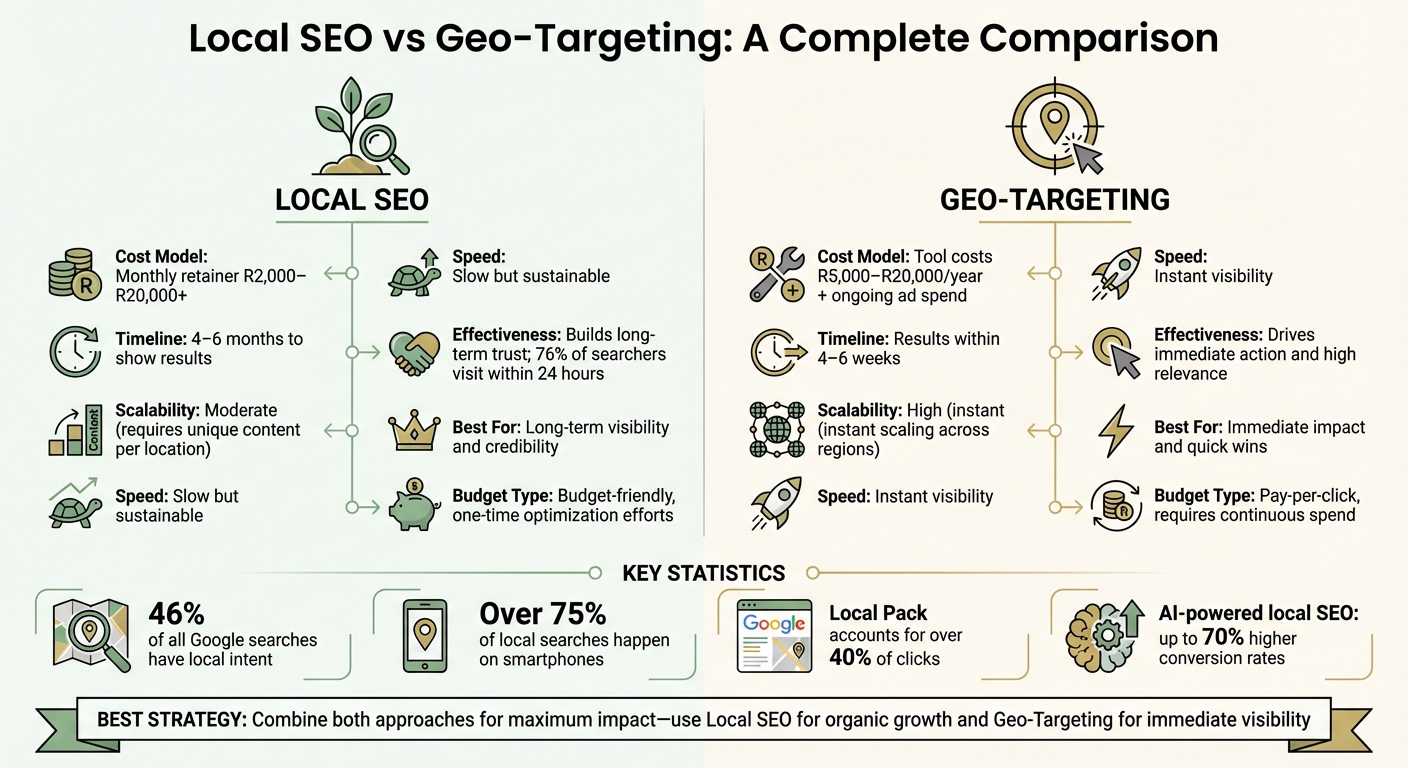
Local SEO vs Geo-Targeting: Key Differences and Benefits for South African Businesses
When weighing up the benefits and drawbacks of Local SEO and geo-targeting, it’s clear that each strategy brings something different to the table. South African businesses need to carefully consider these differences to make the most of their marketing budgets. By understanding where each approach shines – and where it falls short – you can make smarter decisions about your strategy.
Local SEO stands out as a budget-friendly option, especially for businesses operating with limited resources. Entry-level packages typically range from around R2 000 to R5 000 per month. Its biggest strength lies in its ability to deliver long-term results. Once your organic rankings improve, your visibility continues without the need for constant ad spend. However, scaling this strategy can be tricky. Expanding to cover multiple suburbs or cities means you’ll need unique landing pages, fresh content, and consistent citations for each location. This makes Local SEO a slower but more sustainable option compared to geo-targeting.
Geo-targeting, on the other hand, offers immediate visibility and is highly scalable. You can launch a campaign and start appearing in front of local customers within hours. But this approach is heavily budget-dependent. Stop spending, and your visibility vanishes. Additionally, advanced tools for geo-targeting can cost between R5 000 and R20 000 annually, and you’ll need to maintain ongoing ad spend to stay visible.
Here’s a side-by-side comparison of the two strategies:
| Feature | Local SEO | Geo-Targeting |
|---|---|---|
| Cost Model | Monthly retainer (R2 000–R20 000+) | Tool-based (R5 000–R20 000/year) or per-click/campaign |
| Scalability | Moderate; requires unique content for each location | High; can scale across regions instantly via automated platforms |
| Speed of Results | Slow; takes months to mature | Instant; ads appear as soon as the campaign is live |
| Effectiveness | Builds long-term trust; 76% of searchers visit within 24 hours | Drives immediate action and high relevance for timely engagement |
These differences highlight why combining the two approaches often delivers the best results. A hybrid strategy – pairing targeted geo-ads with strong local optimisation – can provide South African businesses with the best of both worlds: quick engagement and lasting visibility .
Conclusion
Local SEO and geo-targeting aren’t rivals – they’re a dynamic duo. Local SEO lays the groundwork by building your organic presence, earning trust through customer reviews, and securing a spot in Google’s Local Pack. Geo-targeting, on the other hand, provides immediate visibility, connecting you with users who are ready to take action. Together, they form a powerful strategy that meets short-term demand while establishing long-term authority.
For South African businesses, this combination is especially effective. Did you know that nearly 46% of all Google searches have local intent? Even more compelling, 76% of local searchers visit a business within 24 hours. Whether you’re a plumber in Pretoria or running a restaurant in Cape Town, showing up in both organic map results and targeted ads ensures you’re exactly where your customers are searching. These statistics highlight the importance of taking actionable steps to dominate your local market.
Start with the essentials: optimise your Google Business Profile and keep your business information consistent across local directories. From there, consider launching geo-fenced ad campaigns targeting specific suburbs or areas within a set radius of your location. And don’t forget about mobile optimisation – most of your audience is browsing from their smartphones. By focusing on these steps, you’ll set yourself up for quick wins and sustainable growth.
"Local SEO is not just another item for the marketing to-do list and it is the fastest way for South African businesses to reach the right people at the right time." – Cloudfusion
FAQs
How do Local SEO and Geo-Targeting work together to improve local visibility?
Local SEO and geo-targeting work hand in hand to help businesses connect with their nearby audience more effectively. Local SEO is all about fine-tuning your online presence for local searches. This includes making sure your Google Business Profile is up-to-date, keeping your NAP (Name, Address, Phone Number) details consistent across platforms, and earning local citations. These steps can improve your rankings in local search results, making it easier for people in your area to find you.
Geo-targeting, on the other hand, leverages tools like GPS and location-based advertising to deliver ads and content specifically tailored to users in a particular area. When you combine these two strategies, you can not only optimise your website and business profiles for local searches but also serve highly relevant ads to customers nearby.
For instance, a business in Cape Town can use local keywords to optimise its listings while running geo-targeted Google Ads to reach potential customers within a specific radius. This dual approach helps increase visibility, attract foot traffic, and engage with local audiences more effectively – whether you’re operating in Cape Town, Johannesburg, or Durban.
What are the cost differences between Local SEO and geo-targeted advertising in South Africa?
The costs associated with Local SEO and geo-targeted advertising in South Africa can vary significantly depending on their scope and the strategies involved.
For Local SEO, businesses typically spend between R2 000 and R20 000+ per month. The exact price depends on factors like the number of locations you’re targeting, the level of competition in your industry, and the complexity of the services provided. This might include tasks such as optimising your Google Business Profile, managing local citations, and creating content tailored to specific locations.
In contrast, geo-targeted advertising – such as Google Ads or geofencing campaigns – has a more flexible cost structure. Pricing depends on campaign size, audience targeting, and the number of impressions. For instance, geofencing campaigns are often billed per 1 000 impressions, with costs ranging from a few hundred rand to several thousand, depending on the campaign’s duration and scope.
While Local SEO offers a more predictable monthly expense, the costs of geo-targeted advertising can fluctuate based on the specific goals and budget of your ad campaigns. Using both strategies together can boost your local visibility and drive highly targeted traffic to your business.
How quickly can you see results from local SEO compared to geo-targeted advertising?
The timeline for seeing results varies depending on the approach. Local SEO usually requires around 1 to 3 months to show visible progress. This is because it relies on organic growth and refining your online presence to rank better in local search results. On the other hand, geo-targeted advertising, like Google Ads, can generate immediate visibility and traffic by using paid campaigns to focus on specific locations.
For South African businesses, blending these strategies can be a smart move. Local SEO helps build consistent, long-term growth, while geo-targeted ads provide quick results and an immediate return on investment.


